Tuesday, January 20, 2015

River City


A year ago I was in Hong Kong and the city was awash in Lunar New Year preparations. Crowded with shoppers, many of whom made commando-raids from the Mainland, stuffing their wheeled suitcases full of chocolates and butter cookies, most of the streets on both sides of the harbor were almost unwalkable. So I often left after breakfast and went to a much smaller city with a much slower pace.

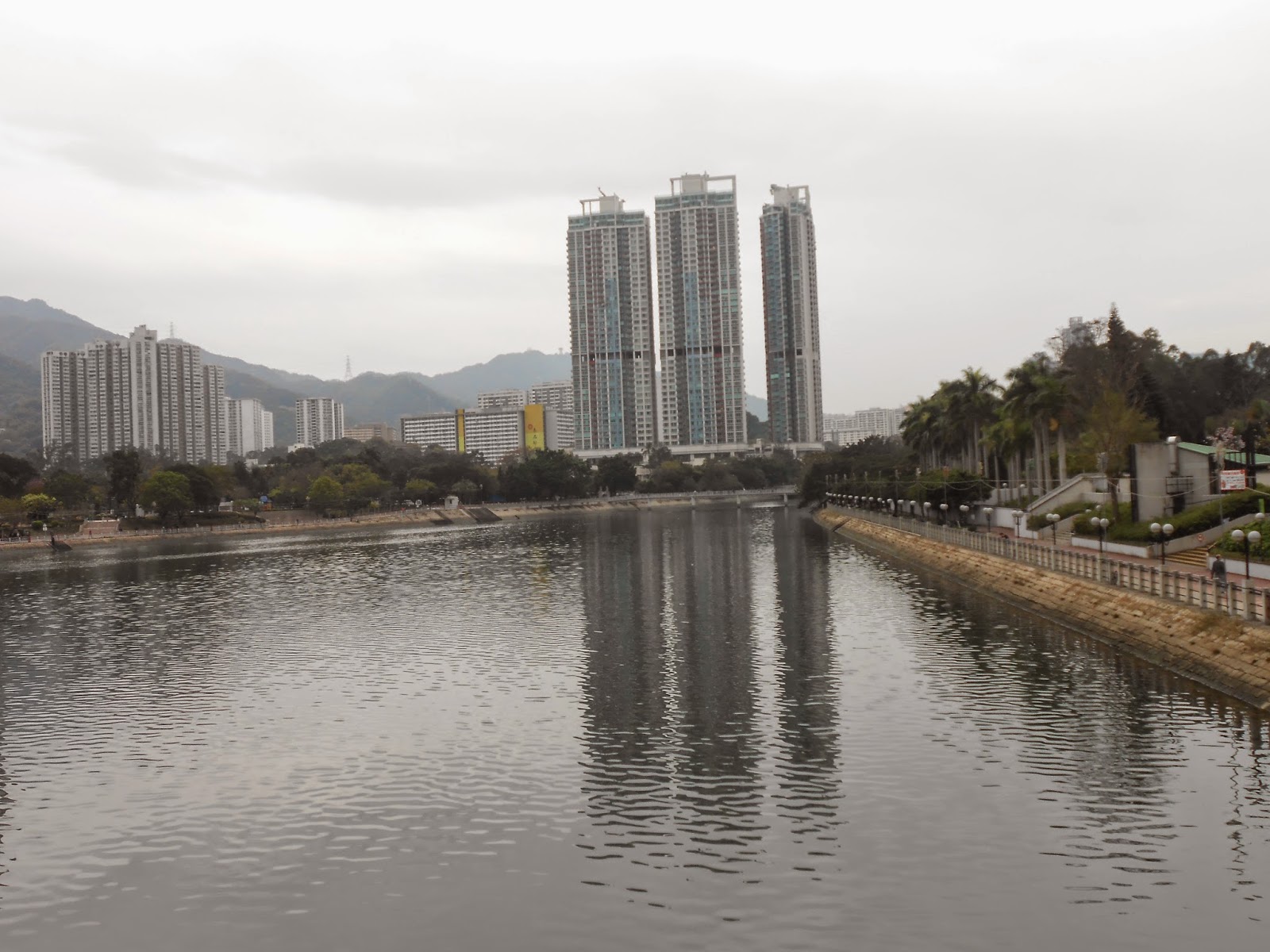
This is Shatin. No, it's not very sophisticated. I like that.


And it's built along a river, which may account for its pace.


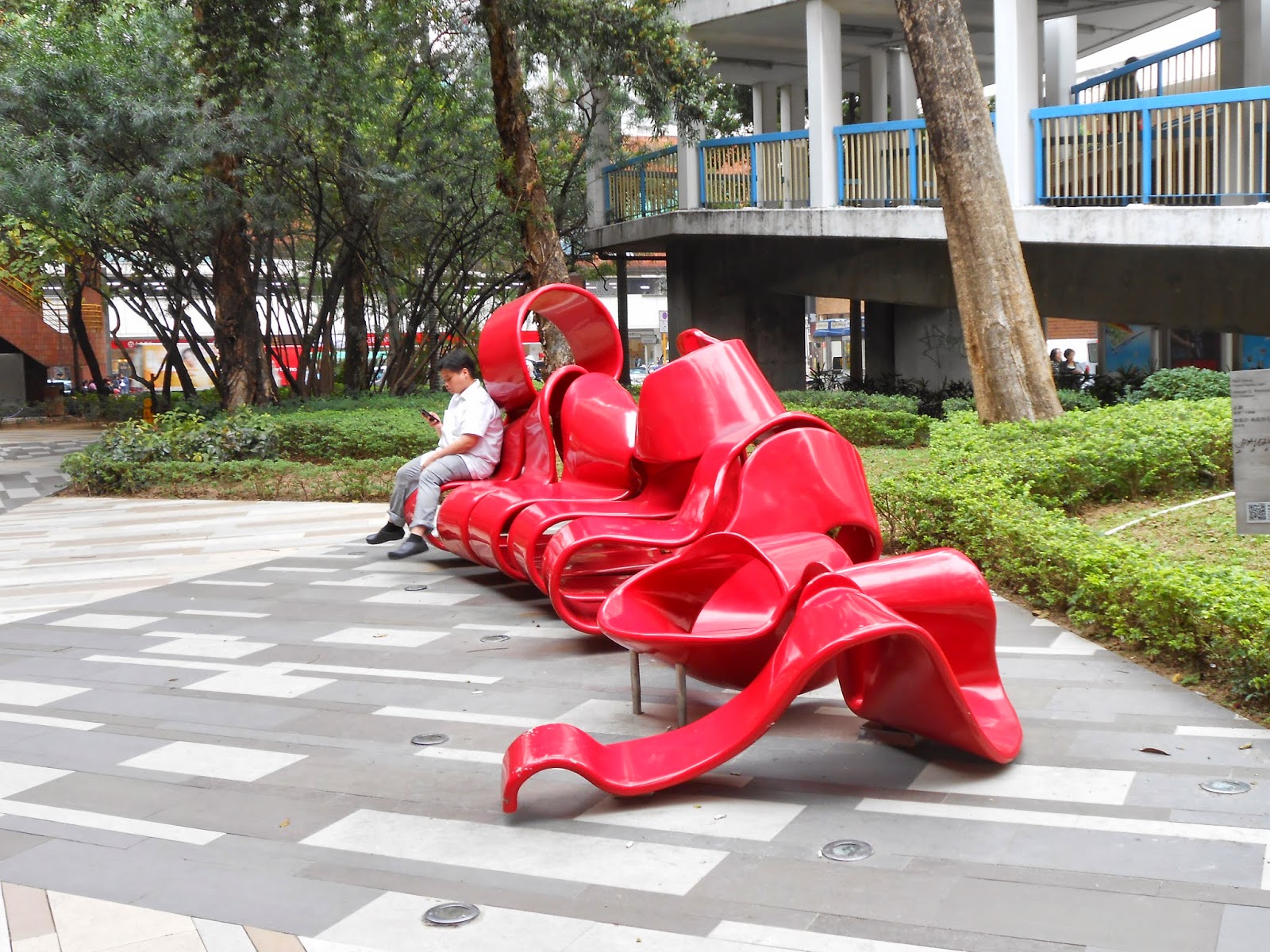
It's the sort of city where you can always find a place to sit.


The public art is exuberant,


and there are egrets. On my first visit there, I came in late afternoon and the riverside trees were filled with them.


But this is what draws me back to Shatin, even more than the river or the wonderful historical museum that I always visit. I caught a glimpse of an old mansion, peering from the trees across the river, silhouetted against the hills.


When I drew closer to it, I saw this.


It is in the middle of a large yard, and is surrounded by a fence. Construction is underway nearby, with makeshift houses for the workers.


This is the lane that runs past it.


Every year, I'm afraid it will be gone, replaced by something like this, that exists in newer communities like Lohas Park,


But so far it still beckons to me each time I go to the river,


with this rising behind it.


It is always a fulfilled promise, each time I go to Shatin.

Tuesday, December 30, 2014

The Deadliest Form of Travel

The latest tragedy involving a Malaysian air carrier dominates the news at year's end and the mystery of why Air Asia's short hop from Indonesia to Singapore ended so terribly is still unsolved. Weather is the most prevalent theory and the most plausible, since it's thunderstorm season in Southeast Asia right now.

This still is a troublesome hypothesis, since flights in that region safely negotiate thunderstorms with regularity; these are not unusual events for airline pilots. What sticks with me are memories of past Air Asia flights and why I no longer use that carrier, even though its fares are often so low that it seems ridiculous not to.

My last journey with Air Asia was from Hong Kong to Penang, a quick flight that takes only several hours. It was so turbulent that the man sitting beside me crossed himself and began to pray, and I have never been so happy to touch Malaysian soil. Other Air Asia flights before that were always significantly more dramatic than I would have liked, although not as consistently bad as my last. "I don't use them anymore," a friend who frequently commuted by air between Bangkok and Ho Chi Min City told me, "I'd rather pay more and have a good flight. Air Asia always ends up frightening me."

"Why didn't the pilot turn back after being denied a change in route?" is a resonant one. Does Air Asia, as a budget carrier, receive routes that are less desirable than other airlines? Are pilots discouraged from aborting a flight? Will anyone ever know?

Still, even Air Asia is a more secure and less dangerous option than the bus journeys that cross Southeast Asia every hour of every day. Fatalities of bus travelers were regularly reported in Penang's daily papers when I lived there, and the Bangkok Post rarely lacks similar stories,

Thailand alone boasts the second-highest rate of traffic deaths in the world, with long-distance buses taking the lead in those fatalities. Recently a tourist van en route to Bangkok's airport crashed into a highway maintenance truck and claimed several lives. Today's news told of severe injuries incurred by tourists in Phuket, when a bus taking them from one beach to another hit a car and "tumbled down a small hill." And truthfully, any of us who have lived in--or visited--Bangkok have faced more danger when taking a motorcycle taxi than on any airplane flight, no matter how turbulent.

But even so, the 7,784 highway deaths in Thailand in 2012 (the most recent statistic that I could find online) dwarfs the 475 deaths in the air worldwide for the same year. What strange mental quirk makes us fear the skill of highly trained pilots and trust in someone who drives blissfully free of any regulation at all?

Sunday, December 28, 2014

Hong Kong to Me


I'm not stealing from Emily Hahn in this title; I'm paying homage. She was the one to first introduce me to Hong Kong in her splendid book, China to Me. When I first went to that city, I walked with Emily through Wanchai, looking for buildings that were of her vintage, loving the ridiculously crowded streets that she would have walked through too.


Then I went to Kowloon, which was a whole other world to Emily. It was to me too. While Hong Kong Island seemed familiar to me, a mixture of Manhattan and San Francisco with Chinese characteristics, Kowloon was like Bangkok on steroids. Everything I loved about Thailand's capital was multiplied here, along with the rampant mall culture which I didn't love at all.


However there were parts of Kowloon that were as chaotic and as fascinatingly ugly as anyplace in Bangkok, and its diversity of population delighted me.


And it was connected to the Mainland. Soon I began to ride the MTR into the New Territories, where different facets of Hong Kong awaited. For me, this is the most interesting part of the former Crown Colony, although some of it made me sad.

This is a residential area developed by the MTR, Lohas Park. It was still being built when I went there. Across the highway were hills with farmhouses and groves of trees. Where I stood, the buildings gave me honest-to-god vertigo when I tried to see their tops.


They formed their own forest that threatened to blot out the sky.

When I traveled on to a completed residential area, Po Lam, the sky was hard to find and pedestrians moved under this landscape. It was a cloudy day but the sky was even darker in this place. Within a few minutes I had to escape in search of light.


And I found it, in an older city that is built around a river. Shatin is my favorite part of Hong Kong because it has been planned for people to enjoy.


And then there are the islands--small communities that retain as much tradition and history as this sentimental traveler could ever wish for.


But as much as I love them, insularity isn't an abstract term. These islands let outsiders come, but they love to see them go.


Unlike Shatin, where people dancing in the riverside often invite me to join the party. Someday I hope I can, for more than an afternoon.

Friday, December 19, 2014

Mix those Blessings


Rites of passage are highway markers. "When I'm six I'll go to school...when I'm thirteen I won't be a child anymore...when I'm twenty-one I can order a cocktail and be served...when I'm thirty I'll have my own house..." Then they begin to lose their luster, slowly but inexorably, and we look for our singularity as they strike--"Forty and thinner than I was at twenty! Fifty and I only have two wrinkles! Sixty and I travel more than I ever dreamed of when I was young."

Then comes the one I can't gloss over--"Sixty-six and my doctor says I have a senile cataract." Oh those medical professionals and their charming terminology!

My eye is now able to see more than I have in a very long time--so much so that I'm already looking forward to the cataract removal in my left eye. But this last month has been difficult for a healthy person--visits to a doctor, eyedrops, being careful of my eye as it heals, to the point that I'm just now resuming my omnipresent eye makeup.

"Can I do this?" has never been something I've asked myself before but I've done it a lot recently. If I ask that often enough, something within me begins to erode. I've always had limitations, based on phobias--water, heights, tight spaces all are barriers to what I have done and will do. But I've had those ever since I can remember. Accepting new limitations is not something I'm willing to do--at least not yet.

However there was a limitation I accepted for years without realizing it, fading eyesight. Now colors are brighter and the outside world holds so many entrancing details when I walk in it. I think again of the May Sarton line, "Lose what I lose to keep what I can keep," and privately alter it to suit my own greedy nature. "Keep what I can keep to mitigate what I lose." And echoing my mother, I tell myself, "It will be all right just as long as I can read."


Sunday, December 7, 2014

No Longer in a Large-Print World

This morning I reduced the type size on my computer screen from 150 to 75 and can see this without strain. One small step. Walks have become more interesting, even on my home turf, because of all the details I can now see. Yesterday I could see leaves on a tree that was two blocks away, and architectural details on the old buildings that make up my neighborhood jump out at me as I walk past. 

I'd begun to dislike walking in downtown Seattle because there was nothing new for me to see. There is now...

So yes I am grateful for the removal of my cataract. But being who I am, I am not wallowing in complete Pollyanna bliss. What I wish I had, in addition to what seems to be a successful surgery, is more information.

Cataract removal is a routine procedure, but not for the person who is going through it for the first time. Up until last week, I hadn't even ever put drops in my eyes. A short tutorial on how to do this--a youtube clip perhaps--would not have gone amiss in my case. The doctor who provides my follow-up care assured me that he is erring on the side of generosity when it comes to the eyedrops--if I miss a few days, it doesn't mean disaster. I suppose if some of the drops spill out of my eye, that is also not the end of the world. So I religiously observe every session of eyedropping every day and hope that regularity will trump ineptitude.

I wish I had been told that my eye would become redder after the first two days post-surgery, that it would water far more than ever before, and that it would puff up at night. Yesterday I woke up in a state of sheer panic because my eye was puffy and I knew it was infected, A call to the doctor's office (closed on the weekend) got me through to an ophthamologist on call. After three key questions she decided this was a normal occurrence--since the seepage from my eye wasn't yellow, my vision was the same as it had been the day before, and my entire eye wasn't red. I wish I had been given those guidelines for assessment with my eyedrops and plastic eyeguard and the ugly sunglasses that I refused to wear. 

I wish I had been told that it is normal for one of my eyedrops to crystallize and that it is all right to remove that dried residue around my eye gently with a towel and warm water. I'd been told not to get water in my eye so avoided it as though I were the devil approached by holy water. 

I know I'm not the only person who wishes that I had more information. Certainly a brochure with FAQs for cataract surgery wouldn't go amiss in doctors' offices--but in the one I go to, the only printed information on hand is a leaflet on different technological breakthroughs in the field of surgery. The most help I've been able to find is online from Britain's NHS.

When I have my other eye done, I won't be wallowing in the ignorance I am now. But for first-time patients faced with cataract surgery, we don't even know what questions to ask. It would be wonderful if doctors realized that and provided information before we go into post-surgery panic.

Thursday, December 4, 2014

And the Scales Fell From My Eyes...

Although my life is often described as minimalist, I relish my creature comforts in a way that only another former Alaskan homestead child could understand. Hot showers may be a standard, unsung feature to some, but to me they are luxuries of the highest order and I never take them for granted, while taking them at least once a day. Without one, I feel like a leper, crying "Unclean! Unclean!" when I venture outside my apartment.

Sponge baths simply aren't an acceptable substitute.

My last shower was on Monday morning; today is Thursday. My hair is unwashed and I feel hideous. To complete this charming picture, I haven't worn my usual eye makeup for four days. Even in the days of my misspent youth, when I dabbled in the counterculture, I still wore eye makeup.

Tomorrow I will be permitted to shower. Today I'm going to have a quick hot bath. I think a turban look is what I'll be going for afterward, swathing my unwashed hair in a colorful scarf. And sunglasses--rose-colored lenses from Bangkok street markets--have proven to be my best friends.

This is the aftermath of cataract removal, along with the inability to read small print at a comfortable distance. For the past decade, I've seen friends resort to reading glasses and felt grateful that I didn't need them. Now--hello, Eyebobs. No, I will not wear them on a little chain around my neck.

This would be much more annoying if I hadn't been given an overriding preoccupation--eyedrops four times a day. For real fun, I can't imagine anything lower on any sort of scale.

And yet colors are brighter, lines are sharper, and street signs are intelligible at a distance. I suppose it's time to stop being a curmudgeonly old harridan and give proper thanks to modern medicine.

Okay. The American Way of Physician's Care has finally justified its existence--but I still think overall it sucks. Maybe I'll feel differently with clean hair but somehow I doubt it.

Sunday, November 30, 2014

Visiting A Cluttered Room

When I commit a poem to memory, I inhabit it. I’m a rapid-fire reader and that doesn’t sit well with a poem. To learn it by heart means that I give full measure to every word. I make it part of my breath. I find different tones and moods in which to present it. I become as close to the poet as it is possible to be. I want to call her and ask why did you use this word and not that one? I want to tell him what his words have become in my life.

And once I learn it, if I try to read the next line through my mind’s eye before I’ve finished reciting the one that is emerging at the moment, I lose the whole damn thing. Speed is not my friend when I come to a poem, I’ve discovered, and that is a revelation to someone who believes rapidity means skill.

Some poems that I loved when I was much younger refuse to stay with me. I loved ee cummings’ Uncle Sol who was a born failure until I tried to learn it. It infuriated me; even as a monologue, it didn’t work for me—much less a poem. “That is or to wit,” made me scream “Satirizing bad language doesn’t make a poem.” What delighted me at sixteen no longer works at sixty-six, and why should I be surprised? I couldn’t keep his jumbled syntax and bad story-telling in place where I wanted it and then I realized I simply didn’t want to.

Is that a clue to what we forget? Do undiseased memories deliberately jettison what is no longer resonant, as well as what’s no longer useful? Do they become over-stuffed and make deliberate choices—“lose what I lose to keep what I can keep”?

I tell myself that I’m losing minutia—who cares what my previous telephone number used to be? When I rummage around my memory, I’m really appalled at the unusable information that lives there. The name of my sixth-grade teacher’s adopted son, really? With all of the little details floating around my brain, no wonder a movie title or two eludes total recall. I only wish I could choose where to hit that delete button, what leaves the recycling bin forever.

But even more interesting to me is what chooses to stick around now, and how that happens. Every day I put two to four lines in my head by writing them down and repeating them over and over. Some are as if I’ve always known them; others twist away repeatedly before they become part of a whole, learned poem. I’ve found that if the poet is writing about something I avoid keeping in mind, like death or stability, I’m resistant to having it part of my memory. Eventually it comes, but those lines take work. So does idiosyncratic syntax, which I edit to my satisfaction. “Consumed with that which it was nourished by” took a couple of days to be accepted without change.

On the other hand, W.H. Auden’s poem, The Walking Tour is going down a treat—imagine that.

Slackened Memory

I’ve always thought we become more ourselves as we grow old, both good and bad intensifying as the years go on. What we lose always seemed an abstraction, “sans teeth, sans hair, sans everything.” It never occurred to me that loss would occur without my knowledge, until I learned that much of the sight in my right eye had gone.

When an acquaintance sent me a May Sarton poem in response to what I wrote about that knowledge, it hit me hard, in the best of ways, and I decided to learn it by heart.

My memory has always been a tool that is easy for me to use. I knew every word in many of my Little Golden Books before I could read and song lyrics stayed with me without effort. The things I couldn’t keep with me were the extraordinary ones, and they were telling: the Confiteor, which I never completely learned, and the times tables, which I eventually and painfully did. When I took a linguistics course in my twenties, I memorized every page of notes that I’d taken for it, handing the notebook to my husband and telling him, “Stop me if I miss a word.” It was all there, I could see each sentence in my head.

So I suppose my memory was photographic. It was certainly word-centered. I could never remember during the course of a day what clothing my children had put on each morning. “If they disappear and the police ask what me to describe what were they wearing, I’ll be hopeless,” I told a friend once. My husband’s mother chalked this up to a lack of common sense; I knew it was probably more akin to brain damage. Words stayed with me, visual details not so much.

This all turned upside down in Thailand. I couldn’t read the words that surrounded me so I began to concentrate on the shapes of the letters. Bangkok’s buildings were often featureless so I fixed my attention on the small things, what was in their windows, the faces of the vendors who sold things on the nearby sidewalks, the food sold from their carts. It was a different way of mapping the world in a city where although the street signs were bilingual, their names in English were in combinations of letters that I’d never seen before. And those letters could change from block to block on the same street; spelling in English didn’t require consistency in the Thai capitol city.

When I returned to the states, I looked at the world differently. This was of course as much to do with my ripening cataract as it was to my change in attention from words to details, but I didn’t realize that. Only recently did I begin to feel annoyed at blurred signs across the street and my  eyes that oddly grew tired after hours of reading.

And I forgot that the brain is a muscle. If parts are unused, they begin to lose their strength. When I began to memorize the Sarton sonnet, the words were reluctant to stay with me. What was worse was that I couldn’t conjure them up in that part of the brain that had always taken the required photograph.

At last after three days of trying, I had almost half of that sonnet with me, but recalling the words wasn’t easy. I rationalized this silently: poems are difficult because of their precision of language. There’s no room for improvising. This poem was difficult because of its subject, which is loss. The one line that resonated most, “This strange autumn, mellow and acute,” became the hardest for me to remember, even though it aptly describes my life. And I had never before tried to learn something from a computer screen.

That is the rationale that makes most sense to me. Every minute I’m looking at something on a screen; the deluge of information is instant, inexhaustible, and ephemeral. I’ve trained myself to read and forget when I turn to that source. Why worry about storing it in my memory when Google will do it for me? I read somewhere that we’ve outsourced our memories, which I believe is true—for me at least.

Just now I tried to remember Robert Frost’s verse about the end of the world. When I mentally pulled up the first lines, I saw them in my own handwriting because I’d once copied them into a notebook for a class I was teaching in Bangkok. When I remember “Under the spreading chestnut tree, the village smithy stands,” I could see the rough, grainy  paper that these words were printed on, the line drawing of the blacksmith, and the shape of the font that conveyed the poem. When I try to remember the Sarton poem, the visual image is the same as the words I’m typing right now, the manuscripts I’ve edited, the e-mails I’ve received for at least a decade. It’s an image so common that it’s become anonymous.

So I’m turning back to adolescence, when I memorized one hundred lines of Julius Caesar by handwriting them over and over. If I write the words of this sonnet repeatedly on paper, will I remember it? And if I repeat them to myself, or read them, before I fall asleep, will they be there in the morning” Is my memory a slackened muscle or an organ that has dissolved?


The peculiar thing is that this morning when the words didn’t fall into my brain, I typed them onto a screen. For the most part, my fingers remembered them, the way they have remembered phone numbers and ATM codes. Are we developing a new, more tactile form of memory? Before I could read, I learned my alphabet by playing with hard plastic capital letters. Learning Braille has taught people a different form of memory. Maybe in old age, we don’t need to lose. We have to rediscover.

Friday, November 14, 2014

November Jasmine


It's very cold by Seattle standards, in the low 40s and dipping below freezing at night. It's my birthday present, what I wished for, cold, sharp sunlight and clear night skies.

In the tradition of granted wishes, this one came with a mean twist. I've been so drained by a cold that I haven't taken the walks I wanted in this perfect form of winter. I watch the light in an apartment that refuses to be truly warm, even though the heat has been turned to high for well over 24 hours.

But that's the price I pay for the big front window that takes up most of one wall and brings me the light that I'm always greedy for. I wear socks and sweaters indoors and in bed at night, happy to pay that price for this pale winter-blue sky and its gift of long shadows.

This morning I walked past a table to get another cup of coffee and there, incredibly, was a small white jasmine flower on the plant I fitfully care for. It holds a faint fragrance and memories of heat and light in another place. This year I inhale, remember, and feel satisfied to be where I am, right now, in this unfamiliar winter.

Saturday, November 8, 2014

I Read the News Today, Oh Boy...


I have a friend who goes to Bangkok a few times every year and stays for several weeks in the same hotel each time he visits. The hotel has copies of the Bangkok Post, which he reads and then brings back to Seattle for me. Last time the paper was filled with news about the new government; this time it was dominated by news of the entrenched junta's accomplishments, especially those of the Prime Minister, whose talents and wisdom seem to have no bounds.

One of the new plans that will be launched in 2016 is guaranteed to change cities in the north, northeast, and south of Thailand, which are (no doubt coincidentally) all areas of concern to the junta.

Twelve border areas are slated to become "special economic zones," with free trade and customs duty exemptions between neighboring countries, which are expected to "attract foreign investors."

One of the targeted districts, the northern city of Chiang Khong, is protesting this plan, saying that in anticipation Chinese investors are snapping up local real estate and driving up prices. Known as a center for culture and natural beauty, Chiang Khong says this plan puts the area at risk of "losing its identity." Fears that industrial factories will be built with accompanying environmental degradation is a large concern, as well as the effect of rapid population growth. At the same time, job opportunities for local residents and a bolstered economy is a large attraction of this plan.

I've yet to go to Chiang Khong, but I have seen other cities that will also become part of this plan. Nong Khai, Mukdahan, and Nakhon Phanom are also on the agenda to become special economic zones, each one a Mekong river town with charm and its own unique character. I've seen how Mukdahan's riverfront has changed over the past five years in response to increased tourism as buses filled with Asian travelers belch their way into the market areas and disgorge travelers daily. It isn't pretty. Local food spots have been replaced with coffee houses that serve mediocre versions of Starbucks offerings along with microwaved meals. Near the tourist office, women arrive in the morning and set up an arena for selling silk. They stand there without enthusiasm all day long, as buses pull up and then roll away. The walkway that runs along the riverbank is clogged with a double row of stalls for at least a mile, selling fabric, clothing, and souvenirs, with still more of the same in the Indochine Market that runs under the walkway. A pretty little restaurant that served Vietnamese food on the banks of the Mekong is now as crowded and lackluster as a foodcourt at any Bangkok shopping mall.

In February I spent half of my Thai time in Nakhon Phanom, which is one of the most delightful places I've ever been in Thailand. A friend who has lived there much of her life told me that real estate prices were soaring. Right now its riverfront is quiet and open to anyone who chooses to enjoy it. Residents come to the old center of the town on weekends to shop on a "walking street" and an old building near the river is the local Indochine Market which is decidedly smaller than Mukdahan's. It is still a Thai city, not a tourist mecca, but soon it may be an economic monster.

But bread and circuses are still the best way to calm a recalcitrant population, and nobody knows better how to accomplish this than the government in Bangkok. That city has spread almost all the way to Khorat and down into Rayong, with business parks and housing developments and superstores. Where to go next? It looks as though they have that all figured out.

The tourist zones are already well established. Now on to the areas that pose a political threat--fill them up with entrepreneurs, bring in the Chinese money, and let the games begin.

And I watch a country I've loved for two decades face the threat of becoming something I will never want to see again. But at least its population will have the disposable income that will allow everyone to come to Bangkok and buy something from the new Embassy shopping paradise, or at Asiatique along the river, or at whatever new behemoth has destroyed yet another neighborhood in Thailand's primate city.